
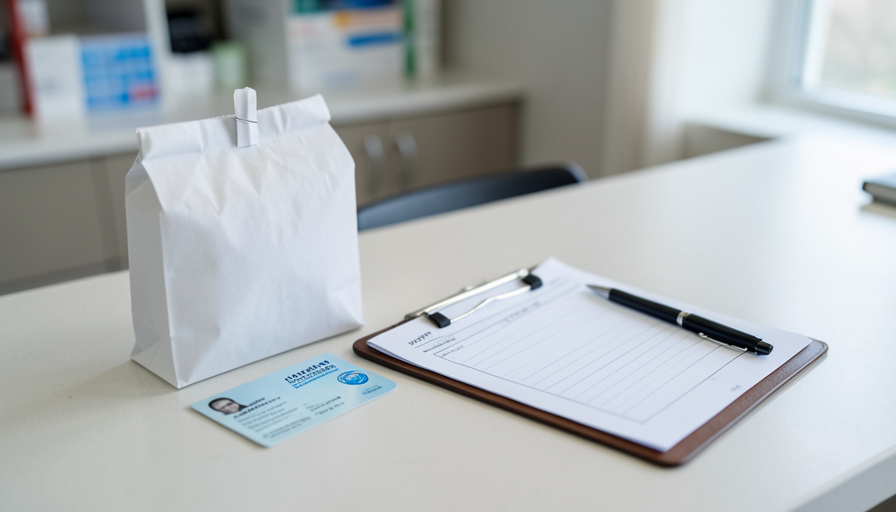
There is no single federal form for picking up someone else’s controlled prescription, which is exactly why the counter can surprise you.
Collecting a controlled medication for a parent, a partner, or a patient you care for feels like it should be simple, and usually it is. What trips people up is the mismatch between what they expect and what the pharmacy actually asks for, because the rules are a patchwork of federal baseline, state law, and each pharmacy’s own policy. Knowing what to bring and what can go wrong turns a potential wasted trip into a two-minute handoff. Here is the practical version, with the caveat that you should always confirm with the specific pharmacy first.
In Brief
- Federal law does not ban a third party from picking up a controlled prescription or set one required paperwork checklist, so the specifics come from your state and the individual pharmacy.
- Bring your own photo ID, the patient’s full name, date of birth, and address, and ideally the patient’s ID or a photo of it. Many pharmacies scan or log the ID of whoever collects a controlled drug.
- Pharmacists can refuse if something seems off, and some chains restrict third-party pickup for certain drugs, so calling ahead is the single best move.
Table of Contents
The short answer: usually yes, with ID
In most cases another person can pick up a controlled prescription for a patient. There is no federal rule that forbids it, and the federal dispensing rules for pharmacies, laid out in the DEA Pharmacist’s Manual, do not impose a single paperwork checklist on the person collecting the medication. What federal law does is classify the drug as controlled, which triggers extra caution. The real requirements then come from two places: your state’s rules and the pharmacy’s own policy. That is why the answer to “what do I need” is genuinely “it depends,” and why the safest preparation is to over-prepare.
What to bring to the counter

Pack these before you go, and you will clear almost any counter:
- Your own government photo ID. A driver’s license, state ID, or passport. Many pharmacies scan or record it when a controlled drug leaves with someone other than the patient.
- The patient’s key details. Their full legal name, date of birth, and home address. Staff often ask for one or more of these to confirm you actually know the patient.
- The patient’s ID, or a clear photo of it. Not always required, but it removes friction, and some pharmacies want to see it for a first-time third-party pickup.
- The prescription number or the patient’s phone number. This helps the pharmacy find the record fast, especially at a busy counter.
- A quick heads-up call. The most useful item is not paper at all. Phoning ahead lets the pharmacy flag the account and tell you exactly what that location needs.
Why controlled prescriptions have extra rules

Controlled substances carry a higher risk of misuse, so states layer identification rules on top of the federal baseline, and those rules vary a lot. Some states require the pharmacist to ask for ID only when the person collecting the drug is a stranger to them, while others require ID from everyone, every time. The differences are wide enough that public health researchers catalog them state by state, as the CDC does in its menu of state prescription drug identification laws. On top of the state rule, the pharmacy may log the collector’s ID into a system meant to deter diversion. None of this means you are under suspicion. It is routine record-keeping for a category of drug the law treats carefully, and proving who you are is the same instinct behind our guide to a failed patient portal identity check.
When a pharmacy can refuse, and how to avoid it
A pharmacist has the professional right to decline handing over a controlled substance if something feels wrong, and that discretion is theirs to use. Common triggers are an ID that does not match the details on file, an expired ID, a collector who cannot answer basic questions about the patient, or a request that seems early or irregular. Beyond state law, some pharmacy chains set their own policy and will not release certain Schedule II drugs, such as strong opioids, to anyone but the patient. That is a store-level rule, not a federal one, and it is exactly the kind of thing a phone call surfaces before you drive over. If you are turned away, ask what specifically was missing so you can return prepared rather than arguing at the counter.
Special situations worth planning for
A few scenarios come up often enough to plan around. Picking up for your own minor child is usually straightforward, since you are the parent or guardian on the account. Collecting for an elderly parent is common and generally fine with their details and your ID, though a first pickup may draw more questions. For an adult who is not a relative, expect more scrutiny, and it helps if the patient has told the pharmacy in advance that you will be coming. If you regularly manage someone’s medications, ask the pharmacy to add you as an authorized contact on their profile, and if you hold a power of attorney or caregiver authorization, bring a copy, because it can resolve a borderline case on the spot.
This article is general information, not medical or legal advice. Rules for picking up controlled substances vary by state and by pharmacy, and they change. For your specific medication, situation, or state, confirm the current requirements directly with the dispensing pharmacy or a qualified professional.
Frequently Asked Questions
Can someone else pick up my controlled substance prescription?
Usually yes. No federal law bans a third party from collecting a controlled prescription for a patient. The person will typically need to show a government photo ID and know the patient’s basic details, and some states and pharmacies apply stricter checks. Calling the pharmacy first to confirm what that location requires is the reliable way to avoid a wasted trip.
What ID do I need to pick up a controlled prescription for someone?
A valid government photo ID, such as a driver’s license, state ID, or passport, is the core requirement, and many pharmacies scan or log it. You should also be ready to give the patient’s full name, date of birth, and address. Bringing the patient’s ID or a photo of it can smooth a first-time pickup, though it is not always required.
Do I need a signed note or power of attorney to pick up a prescription?
Not usually. A signed authorization or power of attorney is not required in most routine cases, but it can help in a borderline situation, especially when you are collecting for an unrelated adult. If you frequently manage someone’s medications, the simpler fix is to have the pharmacy add you as an authorized contact on the patient’s profile.
Why won’t the pharmacy let me pick up my family member’s medication?
The likely reasons are a store or state policy on that specific drug, an ID that does not match or has expired, or missing patient details. Some chains refuse to release certain Schedule II drugs to anyone but the patient. Ask the pharmacist what was missing, since it is often a fixable gap like an authorized-contact note or the patient’s confirmation call.
Can I pick up a controlled prescription for my elderly parent?
Generally yes. Bring your own photo ID and your parent’s full name, date of birth, and address, and be ready for extra questions on a first pickup. Adding yourself as an authorized contact on their pharmacy profile, or keeping a copy of a caregiver authorization, makes repeat pickups faster and prevents most snags.
What To Do Next
The reliable path is boring on purpose. Call the pharmacy, ask what that location needs for a third-party controlled pickup, and bring your photo ID plus the patient’s name, date of birth, and address. If you will do this regularly, get added as an authorized contact so the counter stops treating each visit as new. Confirm first, prepare once, and the surprise disappears. For more practical health and caregiving guidance, browse Wayodd’s Health section, and if you are also fighting a coverage issue, see our guide to appealing a health insurance denial.