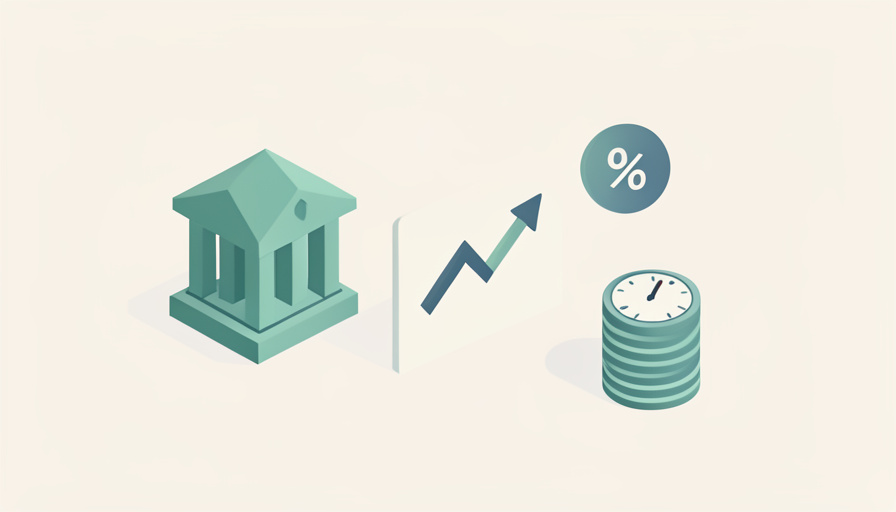

You opened the account at a headline rate that felt great, and a few statements later the APY quietly slid lower. Nothing arrived to warn you. That is not a glitch; it is how variable savings rates work, and it is exactly why chasing them can feel like running on a treadmill.
The HYSA rate change statistics 2026 has produced tell a clear story: the rate you sign up for is not the rate you keep, and the gap between a top account and an average one is enormous. Before you move your money to the next big number, it helps to know how often these rates move, what drives them, and which questions separate a genuinely better account from a teaser. Here are the numbers and the checklist.
Quick Take
- The national average savings rate sat around 0.38 percent in 2026, while top online accounts paid roughly ten times that, near 4 percent.
- The Federal Reserve held its benchmark rate through 2026 after cutting three times in 2025, yet many banks still trimmed savings APYs on their own.
- Because rates are variable and change without notice, a quarterly check and a few switching questions matter more than the headline number.
Table of Contents
The 2026 HYSA Rate Picture
Two numbers frame everything. The national average savings rate stayed near 0.38 percent in 2026, the figure the FDIC tracks across all banks, while the best online high-yield accounts paid close to 4 percent. That roughly tenfold gap, shown in the FDIC’s national rate data, is the whole reason a high-yield account is worth having: the difference on a 10,000 dollar balance is hundreds of dollars a year.
The backdrop was a Federal Reserve that mostly stood still. After three quarter-point cuts in 2025, the Fed held its benchmark rate through 2026, as its record of rate decisions shows. Even so, savings APYs kept drifting. Through the year, more top accounts trimmed their rates than raised them, proof that a bank does not need a Fed move to lower what it pays you.
Why Your Rate Drops Even When the Fed Holds
A high-yield rate is variable by design, and each bank sets it on more than the Fed. Competition for deposits, the bank’s own funding needs, and where it expects rates to head all feed in, so a bank can cut an APY the week the Fed does nothing. Many introductory rates are also time-limited, quietly stepping down after a few months. And the best rates often go to new customers, so the account that was market-leading when you opened it can fall behind while you sit still. None of this comes with a notification, which is why the responsibility to check falls on you.
This article is general information, not financial advice. Rates, account terms, and Federal Reserve policy change frequently, and the figures here reflect 2026 conditions. Confirm current APYs and terms directly with any bank, and consider your full situation before moving money. For personal guidance, consult a qualified financial professional.
Questions to Ask Before Switching Banks
A higher number is only better if it holds and if the fine print does not eat the gain. Before you move your savings, get clear answers to these:
- Is this an intro or promotional rate? Ask what the APY drops to after any promo period and when that happens, so you compare the lasting rate, not the teaser.
- Are there requirements to earn the top APY? Some accounts need a minimum balance, a direct deposit, or monthly activity, and the headline rate quietly falls if you miss them.
- Is it FDIC or NCUA insured? Confirm the account is covered, and if the app is a fintech rather than a bank, check which insured partner bank actually holds your money.
- Are there transfer holds or withdrawal limits? New deposits can be held for several days, and some accounts cap withdrawals per month, which matters if you need access.
- Does this bank keep rates competitive, or teaser then trim? A quick look at how its rate has moved over the past year tells you whether it holds up or fades after sign-up.
- Is the gain worth the hassle? Weigh the extra APY on your actual balance against the tax on interest and the days your money spends in transit, not earning, during the switch.
The Takeaways
- Top online savings paid near 4 percent in 2026 against a national average around 0.38 percent, so the account you pick matters a lot.
- The Fed held rates through 2026, yet banks still cut savings APYs on their own schedules and without notice.
- Intro rates, hidden requirements, and better deals for new customers all erode the rate you actually earn.
- Before switching, confirm the lasting rate, insurance, requirements, holds, and whether the small gain justifies the move.
Frequently Asked Questions
How often do high-yield savings rates change?
There is no fixed schedule. Because HYSA rates are variable, a bank can adjust its APY at any time, often several times a year, and it does not have to wait for a Federal Reserve meeting. In 2026, many top accounts trimmed rates through the year even though the Fed held steady. Checking your rate quarterly is a reasonable way to catch a drop.
Why did my savings rate drop when the Fed didn’t cut?
Because banks set savings APYs on more than the Fed, including competition for deposits, their own funding needs, and expectations of future rates. A bank can lower your rate to protect its margins even when the benchmark holds. Introductory rates also step down on their own timeline, so a rate can fall for reasons that have nothing to do with the latest Fed decision.
Is it worth switching banks for a higher savings rate?
It depends on your balance and the size of the gap. On a large balance, even half a percent is real money and can justify the move. On a small balance, the extra interest may not be worth the paperwork, the transfer time out of the market, and the tax on interest. Compare the lasting rate, not a promotional one, before deciding.
What is the difference between the top HYSA rate and the average?
It is large. In 2026 the national average savings rate tracked by the FDIC hovered near 0.38 percent, while leading online accounts paid close to 4 percent, roughly ten times more. Most of that average is dragged down by big traditional banks paying very little. Moving idle cash from a low-rate account to a competitive one is one of the simplest wins in personal finance.
Do high-yield savings accounts have hidden requirements?
Some do. To earn the advertised APY, certain accounts require a minimum balance, a recurring direct deposit, or a set number of transactions, and the rate drops if you fall short. Others advertise a rate that applies only up to a balance cap, or only as an introductory offer. Always read what conditions apply to the top rate before you assume you will earn it.
Chase the Rate, but Check the Fine Print
A high-yield savings account is worth having, but the headline APY is a starting point, not a promise. Rates are variable, banks trim them on their own schedules, and the best offers often go to new money rather than loyal customers. Know the lasting rate, the requirements, and the insurance before you switch, and weigh the real gain against the hassle. Do that, and you keep more of your interest without spending your life chasing the next number. For more on managing money simply, browse Wayodd’s Finance section.











































No Comments
Leave a comment Cancel