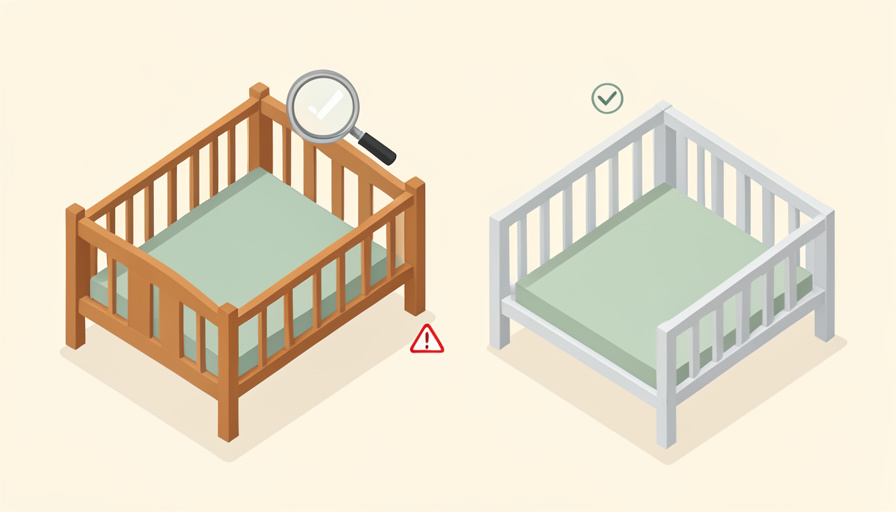

The marketplace listing is tempting: a solid wooden crib, barely used, for a fraction of the store price, and the seller swears their baby loved it. New, the nursery budget groans; used, you could put the savings toward a year of diapers. But a crib is the one piece of furniture your baby sleeps in unsupervised for hours, and the gap between a great deal and a hidden hazard can be a single missing bolt or an inch of loose mattress.
The secondhand crib vs new crib decision is really a safety question dressed as a budget one. A used crib can be perfectly safe and a smart buy, or it can carry a recall, swapped hardware, or a mattress that does not fit, while a new budget crib guarantees current standards but costs more. Here is how the two compare on the checks that actually matter: recalls, hardware, and mattress fit.
Quick Take
- A secondhand crib can be safe and cheap, but only after you confirm it is not recalled, not a banned drop-side, and complete with original hardware.
- A new budget crib guarantees it meets current federal safety standards and arrives complete, which is the reassurance you pay extra for.
- Whichever you choose, the mattress must fit snugly with no gap, and any crib made before 2011 is best avoided entirely.
This article is general information on nursery safety, not medical or product-safety advice. Standards and recalls change over time. Always check current CPSC recalls, follow the latest safe-sleep guidance from the American Academy of Pediatrics, and consult your pediatrician with any concern about your baby’s sleep environment.
Table of Contents
The Case for a Secondhand Crib
A used crib is genuinely appealing. Cribs are sturdy and often barely worn, since babies outgrow them fast, so a secondhand one can look and function like new for a fraction of the cost, and reusing it keeps a big item out of a landfill. The catch is entirely about verification. A secondhand crib is only as safe as your ability to confirm its model, its recall status, its completeness, and its age. Do those checks and a hand-me-down or marketplace find can be an excellent, safe buy; skip them and you are trusting a stranger’s word with your baby’s sleep.
The Case for a New Budget Crib
The premium you pay for new is really the price of certainty. A new crib sold today must meet the current federal safety standards, arrives with all its original hardware and instructions, and carries no history of misuse or unknown storage. Budget models can be inexpensive while still meeting those standards, and many carry a recognized safety certification. You give up the deeper savings of buying used, but you gain a crib you do not have to investigate. For parents who would rather not play detective, that peace of mind is often worth the extra outlay.
Recall Checks Before You Buy Used
This is the non-negotiable first step with any secondhand crib. Get the manufacturer name, model number, and date of manufacture, then check it against the CPSC recall database, since millions of cribs have been recalled over the years. Above all, never buy a drop-side crib: those with a side rail that slides down were banned from sale and resale in the United States in 2011 after being linked to infant entrapment and deaths, and no amount of savings makes one safe. As a rule, avoid any crib made before 2011, when today’s stronger federal standards took effect. If you cannot identify the model or its age, walk away.
The Missing-Hardware Scam
A crib is only safe when it is assembled exactly as designed, which makes hardware a quiet danger with used models. Watch for a crib sold with generic bolts from a hardware store instead of the manufacturer’s original parts, missing pieces, or a listing that glosses over completeness. Substituted or missing hardware can leave a crib wobbly or prone to coming apart, and improvised fixes are how a sturdy-looking crib fails. Insist on all the original hardware and the assembly instructions, and if anything is missing, contact the manufacturer for genuine replacement parts rather than trusting a bin of mismatched screws. If the seller cannot provide complete, correct hardware, treat the crib as unusable.
Mattress-Fit Mistakes
The mattress is where a good crib can still turn dangerous. It must fit snugly against all four sides, with no more than roughly two fingers of gap between the mattress and the crib frame, because a loose mattress creates a space an infant can slip into and become trapped. Use a firm, flat mattress sized for the crib, not a soft or oversized hand-me-down that bulges or leaves corners loose. Check the slats too: they should be no more than about two and three-eighths inches apart, roughly a soda can’s width, so a baby cannot slip through. A snug, firm, correctly sized mattress in a sound frame is the heart of safe sleep.
Which Should You Choose?
Match the choice to your situation and your appetite for verification. If money is tight and you are willing and able to check the model, recall status, hardware, and mattress fit carefully, a secondhand crib from a trusted source can be both safe and a real saving. If you cannot confirm a used crib’s history, or you simply want certainty without the legwork, a new budget crib that meets current standards is the safer default and often not much more than a good used one once you factor in a new mattress. When in doubt about any single check, choose new.
At a Glance: Secondhand vs New
| Factor | Secondhand crib | New budget crib |
|---|---|---|
| Cost | Lowest, often a fraction of new | Higher, but still affordable |
| Meets current standards | Only if made after 2011 and verified | Yes, by law |
| Recall risk | Must check yourself | None on current models |
| Hardware completeness | Verify; watch for substitutions | Complete and original |
| Drop-side risk | Possible; never buy one | Not sold |
| Peace of mind | Depends on your checks | Built in |
Standards and recalls change, so verify the current status of any crib and mattress before use.
Frequently Asked Questions
Is it safe to buy a secondhand crib?
It can be, as long as you verify it thoroughly. Confirm the crib was made after 2011, is not on the CPSC recall list, is not a banned drop-side model, and comes with all its original hardware and instructions. Then make sure the mattress fits snugly and the slats are close enough together. A used crib that passes every one of those checks, ideally from someone you trust, can be perfectly safe and a significant saving. The danger is not buying used itself; it is buying used without doing the verification.
Why are drop-side cribs banned?
Drop-side cribs, which have a side rail that slides up and down, were banned from sale and resale in the United States in 2011 after being linked to numerous infant injuries and deaths. The moving side could detach or malfunction, creating a gap where a baby could become trapped and suffocate or strangle, and millions were recalled. Because the hazard is built into the design, a drop-side crib cannot be made safe, even with a fix kit. If a used crib has a rail that slides down, do not buy it under any circumstances.
How much space should there be between the mattress and the crib?
Very little. A crib mattress should fit snugly against all four sides, with no more than about two fingers of gap between the mattress and the frame. A larger gap creates a space where an infant can slip in and become entrapped, which is a suffocation risk. Always use a firm, flat mattress made for that crib’s size rather than a soft or oversized one that leaves loose corners. If your fist or more than a couple of fingers fit in the gap, the mattress is too small for the crib and should not be used.
What should I do if a used crib is missing hardware?
Do not improvise with generic parts. Missing or substituted hardware can compromise a crib’s structure and cause it to loosen or fail, so replacing manufacturer bolts with hardware-store screws is not a safe fix. Contact the crib’s manufacturer with the model number to obtain genuine replacement hardware and the assembly instructions, and only use the crib once it is complete and correctly assembled. If the maker cannot supply the right parts, or you cannot identify the model, the crib should not be used, no matter how good the frame looks.
Safety First, Then Savings
A crib is not the place to gamble, but it is also not a purchase where new automatically means safe and used automatically means risky. A secondhand crib made after 2011, cleared of recalls, complete with its original hardware, and paired with a snugly fitting firm mattress can be just as safe as a new one and far cheaper. A new budget crib simply hands you that safety without the detective work. Decide based on whether you can verify every check, and when any single answer is uncertain, spend the extra for new. For more on safe furnishings, see our guide to fiberglass in mattress-in-a-box models, or browse Wayodd’s Furniture section.
















































No Comments
Leave a comment Cancel