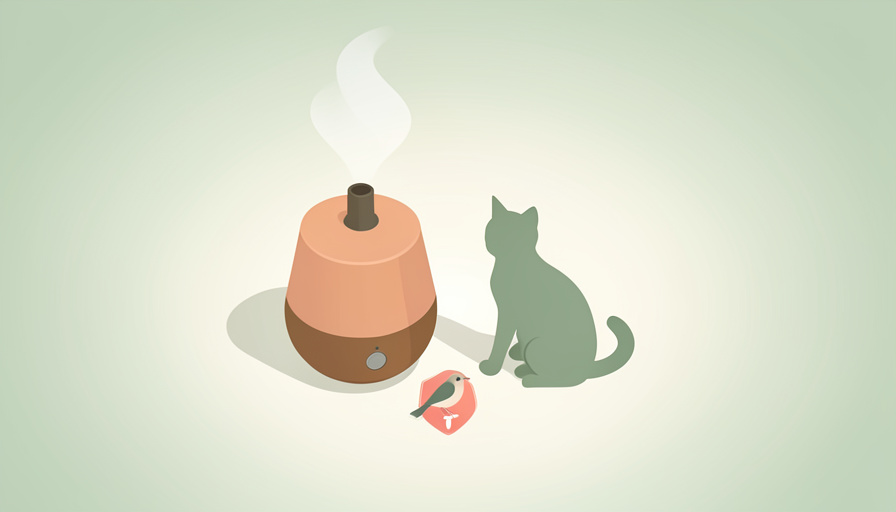

The diffuser is supposed to make the room feel calm. For the cat asleep on the couch, or the parakeet by the window, that gentle mist can be doing something you cannot see. Pets share your air, they cannot leave when it bothers them, and their bodies handle these oils nothing like yours do.
This essential oil diffuser pet safety checklist covers twelve concrete checks, from which oils to keep out of the house entirely to the device settings and ventilation habits that lower the risk. Cats and birds are the most vulnerable, but dogs are not immune. Run through these before you fill the tank, and diffuse in a way that keeps every member of the household safe.
Quick Take
- Several popular oils, including tea tree, eucalyptus, citrus, peppermint, and pine, are toxic to cats and dogs.
- Birds are so sensitive to airborne particles that the safest choice is not to diffuse around them at all.
- When you do diffuse, ventilation, short runs, and giving pets a way to leave the room matter as much as the oil you pick.
This article is general guidance, not veterinary advice. If your pet shows any symptoms after exposure, contact your veterinarian or a pet poison hotline right away. When in doubt about a specific oil or your specific animal, ask your vet before diffusing.
Table of Contents
1. Learn Which Oils Are Toxic Before You Buy
A short list of common oils causes most of the trouble. According to the ASPCA’s guidance on essential oils around pets, oils including tea tree, eucalyptus, citrus, peppermint, pine, cinnamon, wintergreen, pennyroyal, clove, and ylang-ylang can poison cats and dogs. If you live with pets, the simplest rule is to keep these out of your diffuser entirely rather than trying to use them carefully.
2. If You Keep Birds, Do Not Diffuse at All
Birds have a respiratory system built for flight, with air sacs that move air through their lungs with extreme efficiency, which also means they absorb airborne particles far more readily than mammals. A concentration that a cat tolerates can be dangerous to a bird in the same room. The honest answer for a home with birds is to skip diffusing altogether, since even a well-ventilated session carries real risk for them.
3. Never Diffuse in a Closed Room
A pet that cannot leave is a pet forced to breathe whatever you put in the air. Always diffuse in an open space with a door your animal can walk through, so a cat or dog that feels unwell can move to fresh air on its own. Bathrooms, small offices, and any room where a pet naps behind a closed door are the worst places to run a diffuser.
4. Keep the Diffuser Where Pets Cannot Reach It
The most serious exposures are not from the mist but from contact with the liquid. A knocked-over diffuser that a curious cat then walks through and licks off its paws delivers a concentrated dose. Place the unit on a high, stable surface away from counters pets jump onto, and clean up any spill immediately so there is nothing to lick.
5. Choose a Water-Based Diffuser Over a Nebulizer
Ultrasonic water diffusers dilute the oil in a fine water mist, while nebulizing diffusers aerosolize concentrated oil with no water at all. For a home with animals, the water-based type is the gentler option, since the concentration in the air is lower. A nebulizer puts undiluted particles into the room and onto surfaces, which raises both the inhaled and the licked-off exposure for pets.
6. Run Short Sessions Instead of All Day
Newer diffusers advertise continuous and all-day modes, which is exactly what you do not want with pets. Aim for short, intermittent runs of fifteen to thirty minutes with long breaks, rather than a constant haze. Brief sessions let the air clear and keep the total exposure low, and they still scent a room without saturating it for the animals who live there full time.
7. Use Fewer Drops Than the Bottle Suggests
Blend recipes are written for people, not for a five-pound cat sharing the air. Use the minimum number of drops that gives you any scent at all, and add more water, so the mist is as dilute as possible. Less is genuinely safer here, and a lightly scented room is plenty when the goal is a calm space rather than a wall of fragrance.
8. Watch Your Pet the First Few Times
Introduce any diffusing slowly and stay in the room to observe. Signs of trouble in cats and dogs include drooling, squinting or pawing at the face, vomiting, wobbliness, lethargy, or labored breathing. In birds, watch for tail-bobbing, open-mouth breathing, or sitting fluffed and still. If you see any of these, turn the diffuser off, move the pet to fresh air, and call your vet.
9. Never Put Oils on Your Pet or in Their Water
Diffusing is ambient exposure; applying oil directly is a far larger dose through skin or ingestion. Do not dab essential oils on a pet’s coat, paws, or bedding, and never add them to drinking water or food as a remedy. The Pet Poison Helpline’s essential oils overview notes that concentrated skin and oral exposures are the ones most likely to cause serious poisoning.
10. Cross-Ventilate the Room
Fresh air is your best safety tool. Open a window or run a fan to keep air moving through the space rather than letting mist pool, and give the room time to clear before a pet settles back in for a long nap. Good airflow lowers the concentration your animals breathe and shortens how long any residue lingers on nearby surfaces.
11. Clean the Diffuser and Surfaces Regularly
Oil residue builds up in the diffuser and settles on the furniture around it, and a cat that grooms after brushing against those surfaces ends up ingesting it. Wipe the unit and nearby surfaces regularly with a mild cleaner, and empty and rinse the tank between uses so old oil does not concentrate. A clean setup keeps the licked-off exposure that pets are prone to as low as possible.
12. Keep an Emergency Plan on the Fridge
Know what to do before you need to. Cats are especially vulnerable because, as VCA Animal Hospitals explains, they lack a liver enzyme that helps other animals process these compounds. Post your vet’s number and the ASPCA Animal Poison Control line, 888-426-4435, somewhere visible, and if you suspect exposure, call rather than wait to see whether symptoms pass.
Frequently Asked Questions
Are any essential oils safe to diffuse around cats and dogs?
Some oils are considered lower-risk when heavily diluted and diffused briefly in a ventilated room, but no oil is guaranteed safe for every pet, and cats are sensitive to many that dogs tolerate. Because individual animals react differently, the safest approach is to diffuse sparingly, keep sessions short, watch your pet, and check any specific oil with your veterinarian before using it regularly.
Why are cats more sensitive to essential oils than dogs?
Cats lack a liver enzyme that helps break down certain compounds in essential oils, so those substances build up in their bodies more easily. This is why oils that merely upset a dog can seriously harm a cat at similar exposure. It is also why cat owners should be far stricter about which oils enter the home and how they are used.
Can a diffuser really hurt a bird in another room?
It can, because birds are exceptionally sensitive to airborne particles and homes share air through hallways and vents. A diffuser running elsewhere in an open-plan space can still reach a bird’s cage. For that reason, keeping a bird in a separate closed room is not a reliable safeguard, and avoiding diffusers entirely is the recommended choice for bird households.
What should I do if my pet seems affected by the diffuser?
Turn the diffuser off immediately and move your pet to fresh air. Watch for drooling, unsteadiness, vomiting, or breathing trouble, and in birds any labored or open-mouth breathing. Do not wait to see if it improves on its own. Call your veterinarian or the ASPCA Animal Poison Control Center at 888-426-4435, and if you can, tell them which oil and roughly how much exposure occurred.
Diffuse With the Whole Household in Mind
Aromatherapy and pets can share a home, but only when you plan for the animals who cannot choose to leave. Keep the toxic oils out, treat birds as a hard no, and lean on ventilation, short runs, a high shelf, and a watchful eye. The habits that protect your pets cost you almost nothing, and they turn a small daily risk into a non-issue. For more on living well with natural products, browse Wayodd’s Natural Zone section.


































































No Comments
Leave a comment Cancel