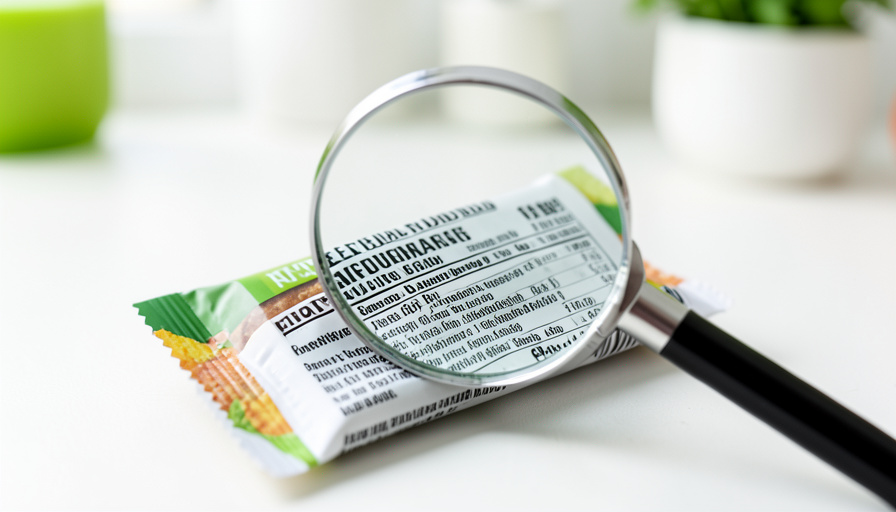

The 12 label checks that separate a genuinely useful GLP-1 snack from a package that just prints the words on the front.
Walk any snack aisle in 2026 and you will see “GLP-1 friendly” stamped on bars, chips, and shakes. The pitch makes sense, since people on medications like Ozempic, Wegovy, and Zepbound eat differently and shop carefully. The problem is that the phrase is a marketing badge, and the useful information is in the Nutrition Facts panel and the ingredient list, where a few specific traps show up again and again.
This is a checklist, not a brand roundup. Learn the 12 checks below once, and you can judge any package in about 20 seconds without trusting the front of the box.
In Brief
- “GLP-1 friendly” is not an FDA-defined claim, so any product can use it. Read the panel, not the badge.
- Two traps matter most for how you feel: sugar alcohols like maltitol that upset an already-slowed gut, and protein that leans on collagen instead of a complete source.
- Two traps matter most for the numbers: shrunken serving sizes and “net carbs” math that has no legal definition.
- The fastest tell of a good snack is a short ingredient list with a complete protein and more protein grams than sugar grams.
At a Glance
| Label trap | What to check first |
|---|---|
| “GLP-1 friendly” badge | The Nutrition Facts panel, not the front claim |
| Collagen protein | Protein source: whey, soy, or pea, not collagen or gelatin |
| Sugar alcohols | Ingredients for maltitol, sorbitol, mannitol |
| Erythritol | Amount, and how many servings you will really eat |
| Serving size | “Servings per container” before you trust the numbers |
| “No added sugar” | Ingredients for polyols and juice concentrate |
| Added fiber | Chicory root or inulin high on the list |
| “Net carbs” | Total carbohydrate, since net carbs is undefined |
| Calorie density | Calories per serving against how filling it is |
| Sodium | The sodium line on savory protein snacks |
| “Protein” bars | Protein grams versus sugar grams |
| “High protein” claim | The actual grams of protein per serving |
Table of Contents
1. “GLP-1 friendly” is not a regulated claim

What to check: the Nutrition Facts panel and ingredient list, not the front-of-pack callout.
The FDA does not define or approve “GLP-1 friendly,” so any brand can print it no matter what is inside, as consumer reporting on the trend has pointed out. Treat the badge as a sign the product is aimed at you, not proof that it fits your plan. Everything that follows is how to check the parts that are regulated.
2. Protein that leans on collagen
What to check: the protein source in the ingredients, whey, soy, or pea versus collagen or gelatin.
Collagen is an incomplete protein, low in the essential amino acids like leucine that trigger muscle repair. That matters because a large share of the weight lost on GLP-1 medications comes from lean muscle rather than fat alone, which is why protein is the top priority for this group. A bar advertising “15g protein” built on collagen counts toward the number but does less to protect the muscle you are trying to keep.
3. Sugar alcohols that upset a slowed gut
What to check: the ingredient list for maltitol, sorbitol, mannitol, and isomalt.
These polyols are poorly absorbed and ferment in the colon, which brings gas, bloating, and diarrhea. On a GLP-1, digestion is already slower, so that reaction lands harder, something people describe constantly in medication forums. Cleveland Clinic notes that maltitol, sorbitol, and mannitol are the worst offenders for digestive distress, and maltitol shows up most often in “no sugar added” treats.
4. Erythritol in stacked servings
What to check: how much erythritol is in the product and how many servings you will actually eat.
Erythritol is gentler on the gut than maltitol because most of it is absorbed before the colon. It is not a free pass by the handful, though: research summarized by Cleveland Clinic links high blood levels of erythritol to major adverse cardiovascular events. A little in one serving is one thing; three servings of an erythritol-sweetened snack is another.
5. Serving sizes shrunk to flatter the numbers

What to check: the “servings per container” line before you trust any other number.
A bag that looks like a single snack is often two or three servings, so the tidy “4g sugar, 120 calories” doubles or triples once you finish it. This is the oldest trick on the panel, and it is easy to miss when a package is clearly one sitting. Your smaller appetite may save you here, but only if you know the real portion going in.
6. “No added sugar” that still works against you
What to check: the ingredients for sugar alcohols, fruit juice concentrate, dates, and honey.
“No added sugar” is a narrow claim about one thing: added sugar. It says nothing about total carbohydrate, natural sugars, or whether the sweetener will upset your stomach. Plenty of “no added sugar” bars are held together with dates or sweetened with polyols, so the phrase alone does not tell you how the snack will sit.
7. Added fiber posing as whole-food fiber
What to check: for chicory root, inulin, or “added fiber” high on the ingredient list.
Isolated fibers inflate the fiber number, which looks great for satiety, but they ferment quickly and cause bloating, again worse when digestion is slow. Fiber from whole nuts, seeds, and beans behaves differently and is gentler. A “12g fiber” bar whose fiber is mostly chicory root is not the same as 12 grams from real food.
8. “Net carbs” math that is not official
What to check: the total carbohydrate line rather than the “net carbs” number alone.
“Net carbs” has no FDA definition. Brands calculate it by subtracting fiber and sugar alcohols from total carbs, on the assumption those do not affect you, which is not always true. Read total carbohydrate and the ingredient list, then decide for yourself rather than trusting the brand’s subtraction.
9. Calorie density hiding in “healthy fats”
What to check: calories per serving measured against how filling the snack actually is.
Nut butters, keto bars, and cheese crisps are nutritious, but fat is calorie-dense, so 300 calories can vanish in two bites with barely a dent in hunger. With a reduced appetite, the goal is protein and volume per calorie, not the reverse. A snack that is mostly fat can quietly use up your day’s small window of appetite.
10. Sodium loaded into savory protein snacks
What to check: the sodium line on jerky, protein chips, and meat sticks.
Savory high-protein snacks often carry several hundred milligrams of sodium per serving, and that climbs fast if a meat stick is your daily go-to. Sodium is easy to ignore when you are focused on protein and sugar, but it is right there on the panel. If savory snacks are your habit, this is the number to watch.
11. Protein bars that are candy bars in disguise

What to check: the sugar, the saturated fat, and the ratio of protein grams to sugar grams.
Some “protein” bars carry as much sugar and saturated fat as a candy bar with a modest protein sprinkle on top. A simple rule cuts through it: the protein grams should be higher than the sugar grams. If a bar has 8g protein and 14g sugar, the label is telling you it is dessert.
12. “High protein” with no grams in view
What to check: the actual grams of protein per serving, not the words on the front.
“High protein” and “good source of protein” are used loosely, and the grams are what count. For real satiety and muscle support on a GLP-1, a snack with roughly 15 to 20 grams of complete protein does genuine work, while a 6-gram snack wearing a “protein” flag does not. When in doubt, the number beats the adjective every time.
How We Chose These
We focused on the traps that show up most on packaged foods now marketed to GLP-1 users, and on the two things this group cares about most: preserving muscle and avoiding gut side effects. We prioritized checks you can do in seconds at the shelf, weighted toward ingredients and Nutrition Facts lines that are regulated and verifiable, and left out vague “eat clean” advice. Where a claim affects how a snack feels or performs, like sugar alcohols or protein source, it ranked higher than a cosmetic one.
This article is general information, not medical or nutritional advice. GLP-1 medications and individual tolerances vary, and side effects can be serious. Talk with your prescriber or a registered dietitian before changing what you eat, especially if you have digestive symptoms or other health conditions.
The Bottom Line
Ignore the “GLP-1 friendly” badge and read three lines: the protein source, the sugar alcohols, and the servings per container. If the protein is complete and outnumbers the sugar, the polyols are absent or minimal, and the serving size matches how much you will eat, the snack is worth buying whatever the front says. Everything else on this list is a refinement of those three checks. If you also use compounded medication, the questions to ask a compounded GLP-1 telehealth service are worth a look, and if you are tracking intake, our guide to a protein tracker that skips calorie counting pairs well with this one.
Frequently Asked Questions
What does “GLP-1 friendly” actually mean on a snack?
Legally, nothing specific. The FDA does not define or regulate “GLP-1 friendly,” so it is a marketing phrase that signals a product is aimed at people on these medications. It usually implies higher protein and lower sugar, but the only way to confirm that is to read the Nutrition Facts panel and ingredient list yourself.
Are sugar alcohols bad if I am on a GLP-1 medication?
They are more likely to cause trouble. Sugar alcohols like maltitol, sorbitol, and mannitol ferment in the gut and cause gas, bloating, and diarrhea, and GLP-1 medications already slow digestion, so the reaction can be stronger. Erythritol is gentler on the stomach but carries its own cardiovascular questions in large amounts. Check the ingredient list and start with small portions.
Why does the protein source matter as much as the grams?
Because a meaningful share of the weight lost on GLP-1 medications is lean muscle, and complete proteins like whey, soy, and pea protect muscle far better than collagen. Collagen is an incomplete protein low in the amino acids that drive muscle repair, so it pads the protein number without doing the same job. Aim for a complete protein source near the top of the ingredients.
How much protein should a GLP-1 friendly snack have?
Roughly 15 to 20 grams of complete protein is a solid target for a snack meant to keep you full and protect muscle. Below about 10 grams, a snack labeled “protein” is doing little for satiety. Pair the grams with a short ingredient list and more protein than sugar, and the snack earns its place.
What is the fastest way to check a snack at the store?
Read three lines in order: servings per container, the protein source in the ingredients, and whether any sugar alcohols are listed. If it is one serving, the protein is complete and outnumbers the sugar, and there are no polyols you react to, it passes. That 20-second scan beats trusting any front-of-pack claim.
Final Word
The snack industry noticed that millions of people suddenly read labels for a living, and it responded with a badge rather than better food in every case. You do not need the badge. Servings per container, a complete protein that outnumbers the sugar, and a short ingredient list free of fermentable polyols will tell you more than “GLP-1 friendly” ever could. For more practical nutrition and label guidance, browse Wayodd’s Diet section.


































































No Comments
Leave a comment Cancel